
5 Best Real Estate Marketing Tools for Agents and Brokers

Real estate marketing has changed dramatically. Today, buyers form their first impression online, often within seconds of seeing a listing. That makes real estate marketing more than advertising, it is about presenting properties in the most compelling way possible. Successful agents combine technology, automation, strong branding, and professional visuals to attract qualified buyers.
This guide explores five essential marketing tools every agent should consider: CRM software, IDX websites, social media platforms, professional photo editing, and video marketing. Used together, these tools create a complete marketing system that generates more leads and helps listings stand out.
Why Real Estate Marketing Tools Matter for Agents and Brokers
Real estate marketing used to mean a yard sign, a newspaper ad, and maybe an open house flyer. That world is gone. Today, the average buyer starts their search online, scrolls through a dozen listings in the time it takes to drink a coffee, and forms an opinion about a property in seconds, often before they’ve read a single word of the description.
That shift has created two problems for agents and brokers.
The first is competition: Every listing is now competing for attention against every other listing on Zillow, Realtor.com, Instagram, and Facebook Marketplace at the same time. Standing out isn’t optional anymore.
The second is time: Between showings, negotiations, paperwork, and client calls, most agents don’t have the time to manage five different marketing platforms by hand. That’s where good tools earn their keep, they don’t just make marketing possible; they make it sustainable.

The One Factor Most Agents Underestimate: Photo Quality
Here’s something that rarely gets enough attention in “marketing tools” articles: none of your marketing works if the photos are weak.
You can have the sharpest CRM, the smartest ad targeting, and a beautifully designed website, but if the listing photos are dim, poorly cropped, or shot at an awkward angle, buyers scroll past before they even click. Studies on online home search consistently point to the same thing: listings with high-quality, well-lit photography get significantly more views and inquiries than listings without.
That’s not a coincidence. It’s why real estate photo editing deserves a spot on this list right alongside your CRM and your website builder, not as an afterthought but as one of the tools actually doing the heavy lifting in your marketing.
Quick Comparison: Top 5 Real Estate Marketing Tools
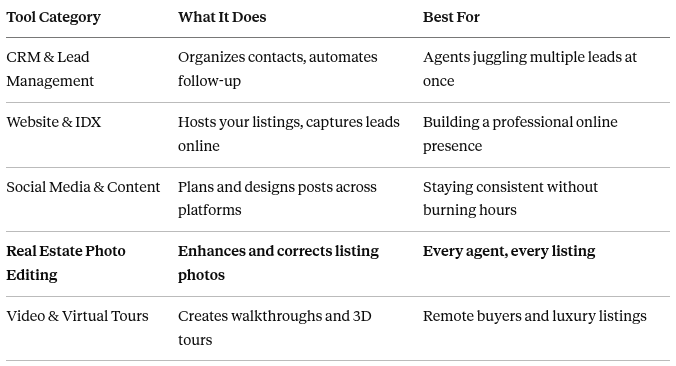
1. CRM and Lead Management Software
A CRM is the backbone of real estate marketing, even though it doesn’t feel like “marketing” in the traditional sense. It’s the tool that makes sure a lead who filled out a form at 11 p.m. actually gets followed up with instead of getting lost in a text thread three days later.
What to look for:
A good real estate CRM should let you track where each lead came from, automate follow-up emails and texts, and remind you when it’s time to check back in. The best ones also integrate directly with your website and ad campaigns, so leads flow in without manual data entry.
Why it matters:
Most deals aren’t closed with the first contact; they’re closed on the fifth, sixth, or tenth touchpoint. Without a system tracking that, leads simply fall through the cracks. Agents who use a CRM consistently tend to convert more of their existing leads instead of constantly chasing new ones.
Who it’s best for:
Any agent handling more than a handful of leads at once, and especially teams where leads need to be assigned and tracked across multiple people.
2. A Website With IDX Integration
Your website is often the first real impression a buyer has of you, not your business card, not your yard sign. If it looks outdated or doesn’t show current listings, that impression works against you.
What to look for:
IDX (Internet Data Exchange) integration is non-negotiable; it pulls live MLS listings directly onto your site so buyers can search without leaving your page. Beyond that, look for mobile responsiveness, fast load times, and built-in lead capture forms.
Why it matters:
A website that just sits there as a digital business card doesn’t do much. A website built to capture leads with search tools, saved property alerts, and clear calls to action turns casual visitors into contacts in your CRM.
One thing worth noting:
Even the best-designed website falls flat if the listing photos on it look flat, too. A clean layout draws the eye, but it’s the imagery that keeps people scrolling and clicking through.
3. Social Media and Content Planning Tools
Social media is where a lot of agents build their personal brand today, but posting consistently without it eating your entire afternoon takes the right tools.
What to look for:
Look for a platform that lets you design graphics quickly (even without design skills), schedule posts in advance across Instagram, Facebook, and TikTok, and see basic performance data so you know what’s actually working.
Why it matters:
Consistency beats intensity on social media. An agent posting three solid updates a week, every week, tends to outperform one posting sporadically, no matter how polished a single post is. Scheduling tools remove the friction that causes most agents to fall off after a few weeks.
Who it’s best for:
Agents building a personal brand or a niche presence (luxury, first-time buyers, a specific neighborhood) rather than just promoting individual listings.
4. Real Estate Photo Editing
This is the one category that quietly makes or breaks everything above it, which is exactly why it belongs on this list.
Think about the buyer journey for a second. Before they ever contact you, fill out a form on your website, or see your social media post, they see a photo. That single image determines whether they keep scrolling or stop to look more closely. No CRM, no ad budget, and no clever caption can undo a bad first photo.
What professional photo editing actually involves:
- HDR blending: combining multiple exposures so rooms don’t look either blown-out white near windows or too dark in the corners
- Sky replacement: swapping a flat, gray sky for a clear or golden-hour one, which noticeably changes how “premium” a listing feels
- Virtual staging: digitally furnishing empty rooms so buyers can actually picture living there, at a fraction of the cost of physical staging
- Color and perspective correction: fixing the color casts and warped lines that come from wide-angle real estate lenses
Why it matters more than most agents realize:
Listings with professionally edited, well-lit photos consistently draw more views and more inquiries on platforms like Zillow and the MLS than listings shot and posted straight off a phone. And because photos are usually the very first touchpoint, better images tend to shorten time on market, buyers who are already sold visually walk into a showing more likely to make an offer.
DIY editing vs. hiring a professional service:
DIY apps work in a pinch, but they’re time-consuming, and it’s easy to overdo HDR or saturation, and photos start looking artificial in ways buyers notice, even if they can’t say why. Professional real estate photo editing services solve exactly that: they make a property look its best while still looking real. For agents listing multiple properties a month, outsourcing this step is often the highest-ROI marketing expense on the list. It takes almost no time on your end and directly affects how many people click through to your listing.
If this is a step you’ve been doing yourself (or skipping), it’s worth exploring what a dedicated photo-editing service can do for your listings.


5. Video and Virtual Tour Tools
Static photos get someone interested. Video and virtual tours get them to actually book a showing, especially for buyers relocating from out of town or shopping in the luxury segment, where “I’ll just drive by” isn’t realistic.
What to look for:
3D virtual tour platforms let buyers “walk through” a home online, room by room, at their own pace. Simpler video tools are useful for quick walkthrough clips you can post to social media or send directly to interested buyers.
Why it matters:
Virtual tours filter out unserious buyers before you ever schedule a showing; someone who’s already toured a home online and still wants to see it in person is a much stronger lead. They’re also a strong differentiator on the MLS, where most listings still only offer static photos.
One overlooked detail:
The thumbnail and preview image for your video tour are still photos. If that first frame is dim or poorly composed, fewer people will click “play” in the first place, which loops right back to why photo quality underpins everything else on this list.
How to Choose the Right Real Estate Marketing Tools for Your Business
Before you sign up for five new subscriptions, it helps to get specific about what you actually need.
Start with your goal. If you’re drowning in leads but struggling to follow up, a CRM will move the needle more than a new social scheduler. If your problem is that listings sit too long, better photography and video will likely have more impact than another ad campaign.
Match the budget to your scale. A solo agent doing 10–15 deals a year doesn’t need the same tech stack as a 20-person team. It’s fine to start lean and add tools as your volume grows.
Check what integrates with what. A CRM that doesn’t talk to your website, or a photo editing workflow that doesn’t fit how you already deliver listings to clients, creates more manual work, not less.
Don’t skip the visual layer to save money. It’s tempting to cut corners on photo editing when budgets are tight, since it doesn’t feel as “essential” as a CRM. In practice, it’s often the cheapest tool on this list relative to the impact it has, because it affects every single listing, every single time a buyer scrolls past it.
Conclusion
The best real estate marketing strategy combines CRM software, a professional website, social media, photo editing, and video marketing. Among these, high-quality listing photography provides the foundation that allows every other marketing channel to perform better. Investing in professional real estate photo editing is one of the simplest ways to strengthen your entire marketing system and maximize listing performance.
Read more:
Virtual Furniture Replacement for Real Estate Marketing