Is AI Real Estate Photo Editing Good Enough to Replace Professional Editors?

AI real estate photo editing has exploded across the industry over the past few years. Type a prompt, click a button, and a dull, overexposed listing photo turns into something that looks camera-ready in seconds. It’s fast. It’s cheap. And it’s raising a real question among agents, brokerages, and photographers alike: can AI real estate photo editing actually replace professional human editors?
The short answer is no, not yet, and not entirely. AI is a powerful tool for speeding up the editing process, but it still can’t replace the judgment, accuracy, and market-specific eye that a trained human editor brings to every listing. Let’s break down what AI real estate photo editing does well, where it consistently falls short, and why the human touch still matters more than most tools admit.
AI real estate photo editing uses machine learning to automatically enhance property photos — fixing exposure, replacing skies, correcting color, and adding virtual furniture to empty rooms, all in seconds and often across entire batches. As listing volume grows and turnaround times shrink, AI has become the go-to fix for both.
AI Real Estate Photo Editing: A New Standard for Listings
AI real estate photo editing uses machine learning to automatically enhance property photos, fixing exposure, replacing skies, correcting color, and adding virtual furniture to empty rooms, all in seconds and often across entire batches. As listing volume grows and turnaround times shrink, AI has become the go-to fix for both.
Common uses include:
- Sky replacement: swap dull, overcast skies for clear blue ones
- HDR blending: merge multiple exposures into one balanced shot
- Color correction: fix color casts from mixed indoor lighting
- Lawn enhancement: green up patchy or dead grass
- Basic virtual staging: add generic furniture to empty rooms
Why AI Real Estate Photo Editing Still Can’t Replace Human Editors
This is the core issue: AI real estate photo editing is a tool, not a replacement for professional judgment. No matter how advanced the model, it still can’t reliably do what an experienced human editor does instinctively.
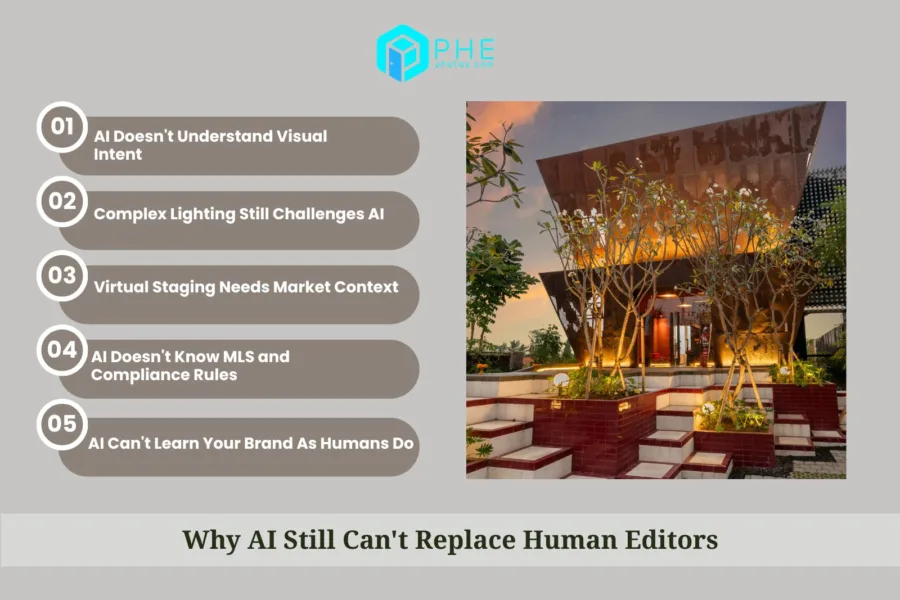
AI Doesn’t Understand Visual Intent
Every property tells a different story. A luxury waterfront estate should feel elegant, bright, and aspirational. A downtown condo may benefit from a modern, high-contrast look that highlights city living. A rustic farmhouse often needs warmer tones to emphasize its character.
AI doesn’t understand these marketing goals. Instead, it applies generalized corrections based on statistical patterns rather than buyer psychology or branding strategy.
These decisions cannot simply be automated. Professional editors make intentional decisions based on:
- Target buyers
- Property value
- Local market expectations
- Agent branding
- Overall visual consistency
Complex Lighting Still Challenges AI
Real estate photography frequently includes difficult lighting situations, such as:
- Backlit rooms
- Bright windows with dark interiors
- Mixed daylight and artificial lighting
- Dark wood interiors
- Reflective surfaces
- Multiple exposure blends
While AI can improve many of these scenes, it often introduces problems like the following:
- Artificial-looking shadows
- Color shifts
- Lost architectural detail
- Over-processed highlights
- Flat contrast
Human editors understand which exposure should dominate each area and can balance the image naturally while preserving realism.
Virtual Staging Needs Market Context
Virtual staging has become one of AI’s most popular applications. However, furnishing an empty room isn’t simply about placing attractive furniture.
Professional editors consider:
- Local design preferences
- Property price range
- Room proportions
- Buyer demographics
- Current interior design trends
AI often generates furniture layouts that feel generic, oversized, or stylistically inconsistent with the property itself. Instead of helping buyers imagine living there, unrealistic staging can actually reduce trust in the listing.
AI Doesn’t Know MLS and Compliance Rules
One of the biggest risks of relying entirely on AI real estate photo editing is compliance.
Different MLS (Multiple Listing Service) organizations and real estate associations have strict rules regarding image manipulation.
For example:
- Removing permanent structures may violate guidelines.
- Altering property conditions can misrepresent the home.
- Excessive virtual staging may require disclosure.
- Certain edits may create legal liability.
AI cannot determine where acceptable enhancement ends and misleading manipulation begins.
Professional editors act as an important quality-control layer, ensuring images remain attractive while complying with industry standards.
AI Can’t Learn Your Brand As Humans Do
Every client has a slightly different preference, like brighter and airier or warmer and more traditional. AI tools apply the same look at scale; they don’t build the kind of ongoing relationship with a brand’s visual identity that a dedicated editor develops over repeated projects.
In short, AI real estate photo editing can move fast, but it can’t replace the eye, accountability, and adaptability of a professional editor. That’s not a temporary gap; it’s a structural one, rooted in what these tools are actually designed to do.
The Hybrid Model: Where Automation Meets Human Expertise
Rather than framing this as “AI vs. human,” the most effective workflows today combine both, and this is precisely why AI hasn’t replaced editors, even as adoption grows.
In a hybrid workflow, AI handles the repetitive, mechanical first pass: initial color correction, exposure balancing, and rough sky replacement across a whole batch of images. That alone cuts editing time significantly. Then a trained human editor reviews every image, corrects anything AI got wrong, and applies the market-specific finishing touches that automated tools simply can’t replicate.
The result is the best of both worlds: the speed of AI real estate photo editing, combined with the judgment and accountability of a professional editor. Clients get fast turnaround and photos they can trust without the risk of an AI artifact slipping into a live listing.
Automated vs. Hybrid vs. Fully Manual Editing: A Quick Comparison
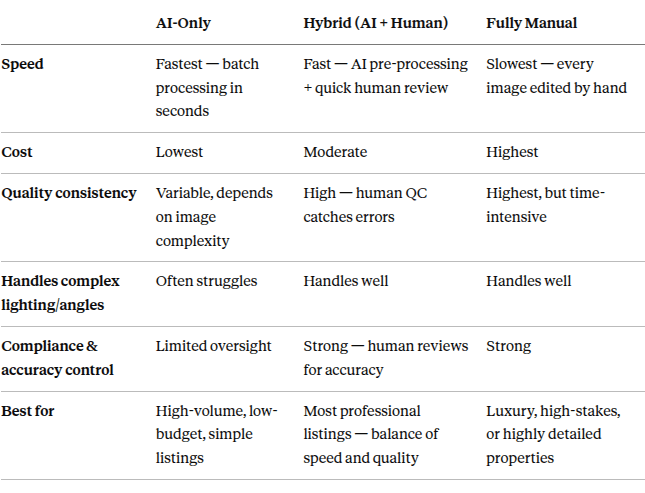
For agents managing dozens of listings a month on a tight budget, AI-only tools can be a reasonable option for simple properties.
But for anything client-facing where brand reputation and listing performance matter, the hybrid model is increasingly the industry standard; it delivers professional-grade results without the turnaround times of fully manual editing.
The Future of AI Real Estate Photo Editing
AI real estate photo editing will keep improving. Routine editing tasks will become increasingly automated, allowing professionals to spend less time on repetitive corrections and more time making creative decisions.
But none of that changes the fundamental role of the human editor; it only shifts it. Instead of manually adjusting every pixel, professional editors are increasingly acting as quality supervisors, guiding AI tools, catching what they miss, and applying the market-specific judgment no model has learned yet.
For the foreseeable future, the winning formula isn’t “AI vs. human.” It’s AI accelerating the work, while human editors make sure the final result actually sells the property, and that’s exactly why AI real estate photo editing, on its own, still can’t fully replace professional editors.
FAQ
Can AI real estate photo editing replace human editors? No, it speeds up editing but can’t replace human judgment and accuracy.
Can AI edit real estate photos as well as a human editor? For simple images, yes. For complex lighting or high-end listings, not quite.
Does using AI editing affect a listing’s credibility? Yes, if edits look unnatural or unrealistic.
How does the cost of AI editing compare to professional editing services? AI-only is cheapest; hybrid costs slightly more for much higher quality.
Should a small real estate business use AI instead of hiring an editor? For simple, high-volume listings, yes. For high-stakes ones, a hybrid service is better.
Read more:
Aerial Photo Editing for Stunning Drone Images
How to Build Client Trust with Real Estate Photo Editing
Day-to-Dusk Real Estate Editing for Stunning Property Listings